
Our story
Discover our rich radio history
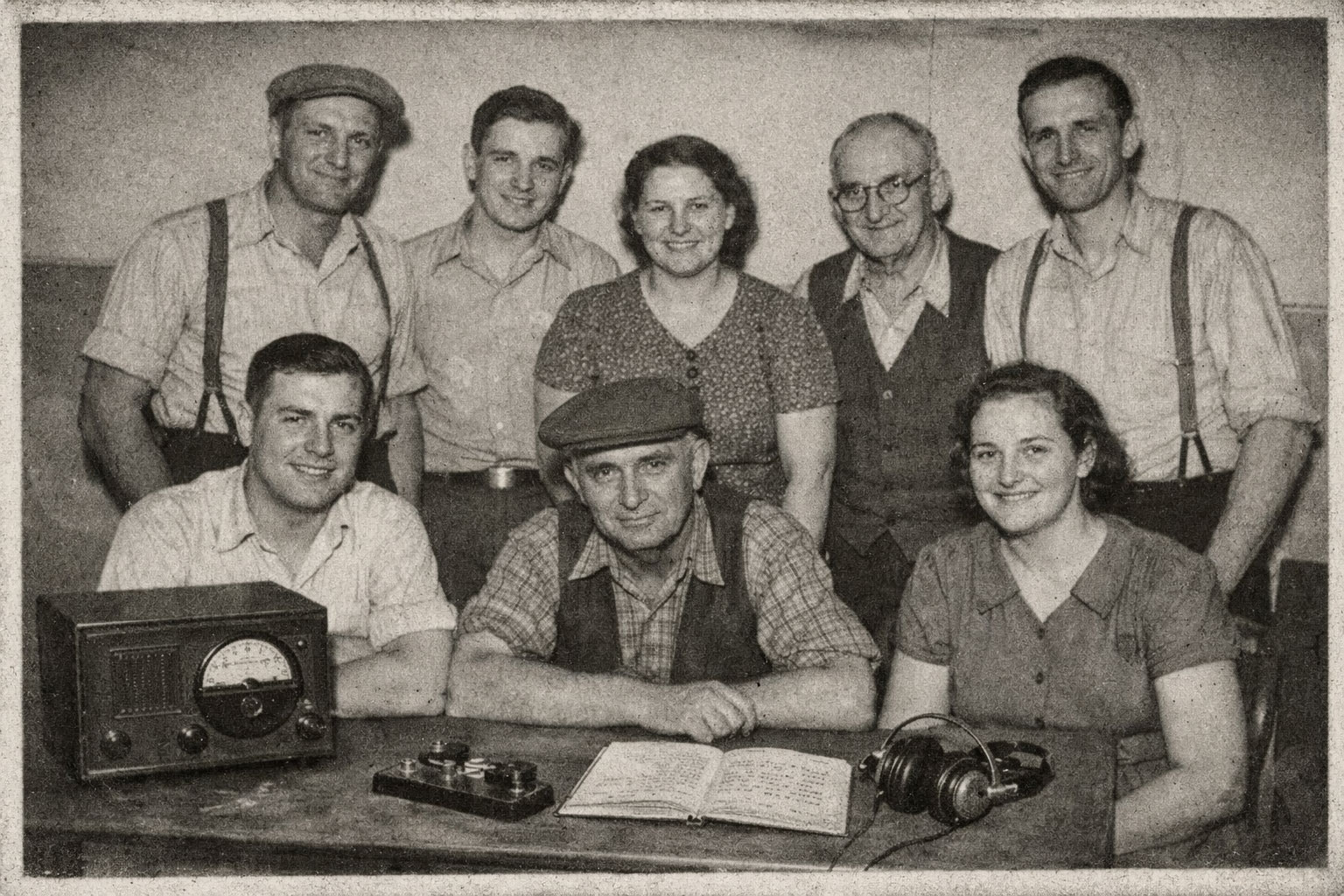
The history of the Susquehanna Valley Amateur Radio Club spans many decades and many voices. Like most long-standing amateur radio clubs, our story isn’t a perfectly continuous timeline. It includes periods of strong activity, quieter years, and moments preserved only through photos, call signs, and shared memories.
What follows is our best effort to document that history as accurately as possible. Some dates are certain; others are approximate. This timeline will continue to grow as new information is discovered and shared.
If you recognize a name, remember an event, or can help fill in a missing chapter, we invite you to help preserve the club’s history.
1938 – 1941
Early Years and First Hamfests
The earliest known evidence of the Susquehanna Valley Amateur Radio Club dates to 1938, based on a photograph that surfaced in 2014 from the daughter of Lloyd Sherman. The image shows a group identified as the Susquehanna Valley Amateur Radio Club gathered for what is labeled the “Fourth Annual Hamfest” at Rolling Green Park on July 13, 1941.
The reference to a “fourth” annual event strongly suggests that organized club activity began several years earlier. Rolling Green Park, a 46-acre amusement park along Routes 11 & 15 in Hummels Wharf, served as an early gathering place for club events.
1941 – 1945
World War II Interruption
Following the attack on Pearl Harbor in December 1941, the U.S. Congress suspended all amateur radio operations nationwide for the duration of World War II. Like countless other amateur radio clubs, SVARC ceased operations during the war years.
1945 – Late 1950s
Post-War Reorganization and Sparse Records
After the war ended in August 1945, the club appears to have regrouped quickly. A copy of SVARC’s Constitution and By-Laws dated 1945, provided by Bill Beck, confirms formal post-war organization.
Unfortunately, few additional records survive from the late 1940s and early 1950s, making this period difficult to document in detail.
1950 – Early 1960s
A Stable Club Home and Active Hamfests
By 1958, SVARC was clearly active again. Meetings were held in a small building on Mile Hill Road in Upper Augusta Township. Though primitive by modern standards—with no running water or sewer—the property provided ample space for antenna installations.
Hamfests continued at Rolling Green Park through the late 1950s and early 1960s. A surviving program from the August 4, 1963 Hamfest documents club officers, members, committee chairs, sponsors, and activities, including a fox hunt coordinated that year by Bill Beck.
1961 – Mid 1960s
Relocation and Gradual Decline
Sometime before 1961, the club moved to another small building near what is now the Upper Augusta fire station. Whether the building was owned, leased, or constructed by the club remains unclear. A small antenna mast remained on the structure for decades afterward.
By the mid-1960s, membership activity declined. Between 1964 and 1971, the club appears to have disbanded once again, and the property was eventually sold.
Late 1970s
Reformation and a New Beginning
SVARC was formally reestablished in the late 1970s, marking the beginning of its modern era. A new Constitution and By-Laws dated October 1978 list officers, members, and signatures confirming renewed organization.
From this point forward, the club remained active without interruption.
1978 – 1997
A Club on the Move
Between 1978 and 1997, SVARC met in numerous locations throughout the region as opportunities arose. These included:
-
Penn Valley Airport lounge
-
Private residences
-
Snyder County Emergency Operations Center
-
Susquehanna University
-
Selinsgrove Community Center
-
PEMA headquarters at Selinsgrove Center
-
Northumberland County Courthouse Annex
-
Commissioner’s Room in the Courthouse
-
The Bittner Building in downtown Sunbury
During this era, the club became increasingly involved in public service and emergency communications. Members helped maintain the 147.180 and 146.820 repeaters for Snyder County EMA and supported local agencies.
In 1988, SVARC became officially affiliated with the ARRL.
1997 – 2018
The Penn Valley Airport Clubhouse Era
Around 1997, the club secured use of a former Civil Air Patrol building at Penn Valley Airport in Selinsgrove. Though a lease existed, it appears the arrangement functioned largely as a goodwill agreement in exchange for building maintenance and improvements.
This period marked one of the most stable and productive eras in SVARC history. The building became a true clubhouse, outfitted with radios, towers, wire antennas, heating, air conditioning, and a new metal roof. The club regularly hosted operating activities, Field Day events, and participated in the PA QSO Party.
In 1998, SVARC held a special event station marking the 10th anniversary of its ARRL affiliation. The club’s logo—designed by Tom Shambach and later digitized by Tim Gelvin—originated during this period.
SVARC also provided communications support for the Lewisburg Arts Festival for many years, gradually expanding its role beyond communications into traffic control.
2000s – 2018
Emergency Communications and Repeater Challenges
Throughout the 2000s and early 2010s, many members were involved with ARES and emergency communications. Relations with Snyder County EMA fluctuated over time, particularly concerning repeater coordination and site access.
By the mid-2010s, coordination issues and interference complaints—especially involving the 146.82 repeater—led to difficult decisions. Eventually, the 146.82 repeater was shut down, and access to repeater sites was lost following the formation of a regional 911 center.
2018 – 2019
Leaving the Airport
In 2018, the airport authority announced infrastructure upgrades that would require removal of SVARC towers and installation of costly FAA-mandated lighting. With future demolition of the building planned, the club made the difficult decision to leave the airport.
Equipment was auctioned, donated, sold, or placed into storage. Towers and antennas were removed, and by January 2019, SVARC formally vacated the clubhouse.
2019 – 2020
Transition and the End of Arts Festival Support
Following the 2019 Lewisburg Arts Festival, the club ended its long-standing involvement. Volunteer fatigue and concerns over FCC rules regarding compensation for public service events contributed to the decision.
Monthly meetings moved to Brookside Ministries in Shamokin Dam, providing stability during a transitional period.
2020 – 2021
Pandemic and Virtual Operations
The COVID-19 pandemic forced a rapid shift to online meetings via Zoom, ensuring continuity during unprecedented circumstances. During this time, efforts were made to modernize the club’s website and formally document SVARC’s history before memories and records were lost.
In May 2021, in-person meetings resumed at Brookside Ministries.
2021 – 2023
ARES Suspension and New Approaches
Changes to ARRL ARES requirements, combined with declining participation, led to the resignation of local Emergency Coordinators in 2021. Later that year, all ARES activity in Snyder and Northumberland counties was formally suspended by the ARRL section leadership.
In response, SVARC reactivated its Emergency Communications Support Committee, allowing members to continue supporting emergency preparedness in alternative ways.
A Winlink Wednesdays Net was established to maintain emergency communications skills and FCC-compliant public service activity.
2023 – Present
A New Chapter
By 2023, legacy radio equipment from the airport era was deemed no longer practical to maintain. Remaining items were sold or donated, and proceeds returned to the club treasury.
Beginning in January 2024, SVARC moved its monthly meetings to STEAM Innovation Labs in Sunbury, positioning the club among other technically minded groups and opening new opportunities for outreach, collaboration, and growth.
Although repeater coordination challenges remain unresolved, the club continues to operate weekly nets and adapt to changing circumstances—just as it has done throughout its long history.
A living timeline
SVARC’s history is one of resilience, reinvention, and community. From pre-war hamfests to modern digital communications, the club has endured because its members have consistently adapted to change.
This timeline is not an endpoint, but a foundation—one that future members will continue to build upon.